
A Roman Classic Travertine residential powder-room vanity needs more than a compelling stone photograph. The supplied BV slab is Vein cut, honed and filled, 119 × 71 IN × 2 CM. Its actual photographed pattern is the selection reference; support, fabrication and the completed assembly require separate approval.
For interior designers, architects and developers, start with Roman Classic Travertine as a particular material selection. Compare the slab range if the project requires a different finish, format or appearance rather than forcing an unsuitable selection into the drawing.
Start with the application and the people using it
The generated concept studies an approximately 48 × 22 IN supported vanity top with an inset basin and a separately cut low upstand. These are visual study dimensions, not a cutting schedule or an approved assembly. Resolve door swing, basin reach, tap projection, guest storage and plumbing access before the stone is ordered.
A compact powder room is a composition of small clearances. Draw the door swing and the standing position at the basin before selecting the mirror or faucet. Coordinate wall-mounted tap projection with the actual basin template so the water stream lands correctly. Show service access within the painted cabinet rather than hiding an unresolved plumbing route behind stone.
The architect and general contractor should coordinate interfaces and access; the stone specialist and fabricator must resolve support, attachment, sound material and edge details. A 2 CM label cannot establish allowable spans. Discuss the scope through custom capabilities and obtain a section through the actual assembly.
Ten benefits to evaluate during design development
These are conditional design and coordination opportunities, not tested performance claims.
A light counterpoint. Cream and beige stone can contrast with a darker powder-room wall, subject to the actual sample.
Fine horizontal movement. The supplied fine waves can establish a restrained direction across a small top.
Basin-scale detail. Mineral variation remains visible at the close viewing distance of a compact vanity.
Defined honed finish. A honed sample gives the lighting review a consistent finish reference.
Filled face assessment. The filled specification directs the sample review toward the actual face without assuming filler chemistry.
Known starting format. The verified119 × 71 IN format starts the cutting discussion but does not establish usable yield.
Thin-edge proportion. Nominal2CM can form a clear edge above painted joinery when properly supported.
Separate upstand coordination. A low upstand can relate the top to the wall while its joints and orientation remain explicitly drawn.
Focused material allocation. A small vanity introduces the material without requiring every surface to be stone.
Compact approval package. Basin template, tap position, sample and cabinet section can be reviewed together before fabrication.
Keep the slab layout faithful to the selected piece
Gross slab dimensions do not guarantee that every nominal rectangle can be cut. Mark sound working boundaries, trimming, exclusions and orientation on a current slab photograph. Ask the fabricator to show each proposed part at a credible scale before approving the slab layout.
Do not shrink the whole photograph into every small top or stretch it across an oversized wall. Separate pieces need individual layouts and realistic joints. Visual similarity is not a bookmatching promise or a guarantee of matching replacement material. Retain the approved photograph and sample with the relevant catalog information and material collection references.
Review the finish and the operating conditions together
The supplied finish is Vein cut, honed and filled. A general filled and unfilled travertine guide explains filling natural voids; it does not establish this slab’s filler chemistry or certify the proposed application. Obtain relevant product and fabrication information rather than assuming all filled travertines behave identically.
The Natural Stone Institute care guidance supports stone-appropriate cleaners and caution with acidic products on calcareous stone. Confirm the actual stone, fill, finish and any treatment before choosing cleaners. A sealer does not make stone stain-proof; plan prompt spill response and an agreed care procedure.
A New York or Chicago designer can review the sample with the operator and contractor; teams in Miami, Denver, San Francisco and Utah can follow the same approval sequence using their project’s own lighting and requirements. These are procurement examples, not local-project, inventory or climate claims. A landscape architect considering an exterior adaptation needs a separate exposure and assembly review.
Questions to resolve before fabrication
Does a honed filled vanity form a waterproof bathroom assembly?
No. Basin interfaces, joints, substrate and water management remain assembly decisions. Neither the honed finish nor the filled face certifies waterproofing. Obtain the necessary project-specific review. Use the DOMVS FAQ to organize initial enquiries rather than as an installation specification.
What does a travertine versus soapstone comparison tell the team?
It is a starting question rather than a universal ranking. Compare actual samples, finishes, maintenance and assembly requirements. Review current material options with the client’s priorities in view; a material name alone cannot resolve suitability.
Can the same slab language support a different design?
The distinct social concept explores a retail jewellery consultation table. It is a separate installation study, not a crop of the main image. Its geometry and support need their own approval; neither image is a completed DOMVS project or evidence of engineered performance.
Bring the sample and the detail to one approval meeting
Use the design trade programme to discuss the selected piece and intended scope. A complimentary design consultation can frame the selection questions. Request a Roman Classic Travertine BV sample or project quote with the drawing, quantity and intended application.
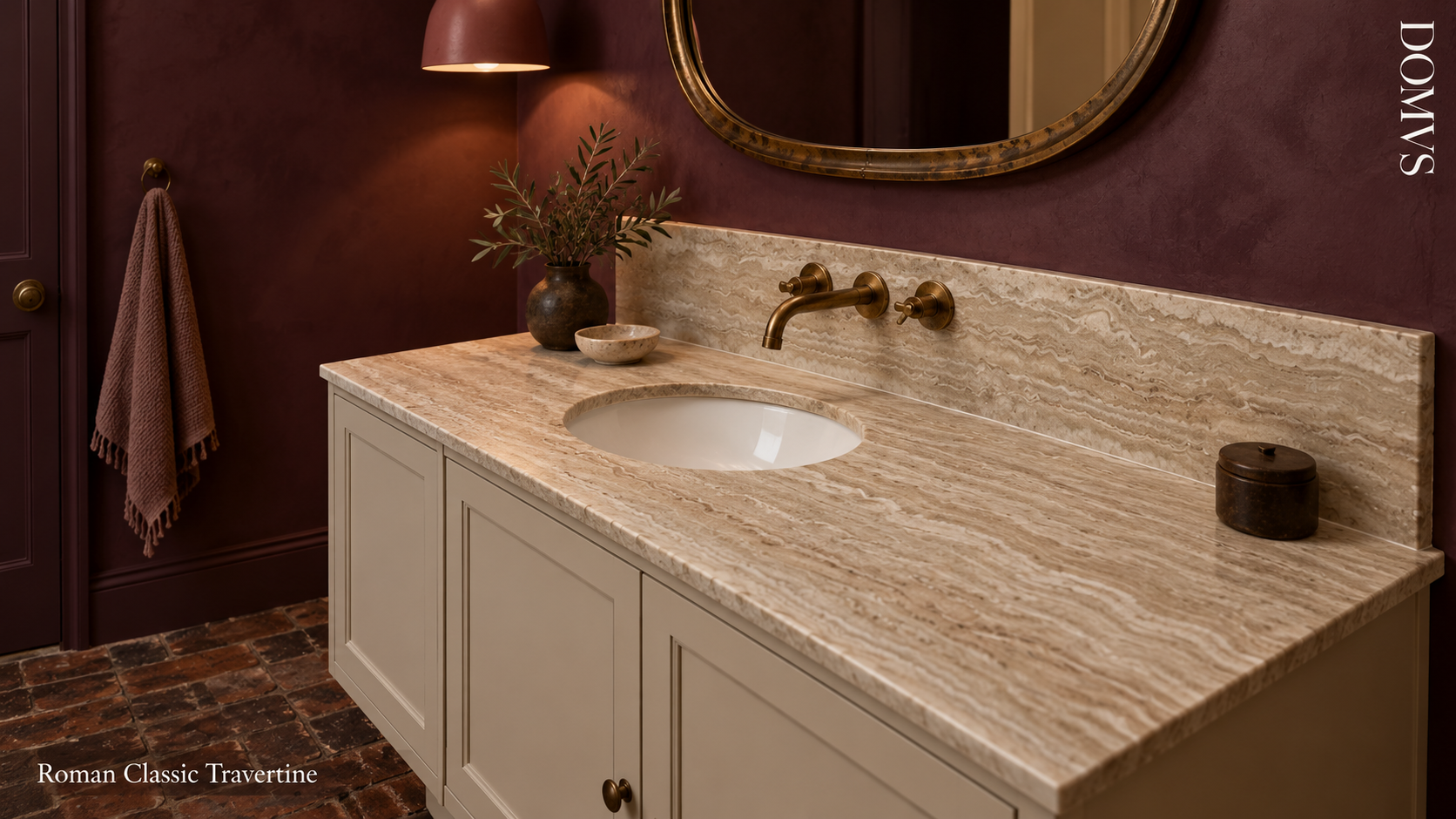
Generated residential powder-room concept. Basin interfaces, water management and stone support require project approval; not a completed DOMVS project.