
Soapstone countertops can be a design candidate for retail consultation areas when the team accepts the material's appearance and maintenance expectations and verifies the actual assembly. Black Philadelphia Soapstone offers a near-black field with fine pale veining in the supplied 3 CM honed RT slab. Begin with a sample, the activities at the counter and a care discussion rather than treating a dramatic photograph as a performance specification.
Start with the soapstone slab gallery and the wider slab selection. Review current arrivals for related options, then confirm which actual slabs can be allocated. These pages support selection; they do not replace batch approval.
Begin retail counter design with the actual activities
A retail consultation counter may support product presentation, paperwork and conversation. Identify the objects that will contact the surface and the cleaning products staff use. Interior designers should review the stone beside merchandise and upholstery, while operators should assess the practical consequences of wear. A visually quiet surface can be useful, but color alone says nothing about scratch resistance or the suitability of a cleaning chemical.
Use the DOMVS catalogs to compare the surrounding finish palette. Where a detail needs further coordination, discuss the brief through custom capabilities before assuming a size, edge or installation method is available.
Evaluate the honed soapstone countertop finish honestly
The Natural Stone Institute's soapstone care guidance notes that scratches are an expected consideration and that oiling is an optional appearance choice. Discuss both with the supplier and fabricator using the actual finish sample. Do not describe this slab as scratch-proof or maintenance-free. If treatment is proposed, approve the resulting color and routine before specifying the whole counter; the supplied dark photograph is not a promise of an untreated or permanently uniform color.
Coordinate soapstone slab selection, edges and access
A 3 CM soapstone label does not determine spans, edge profiles, attachment, backing or cutout details. The architect and fabricator should resolve those items for the complete design. Keep service access and cable routes coordinated with the joinery. Mark the principal vein areas on the shop drawings so a fine diagonal line is not unexpectedly broken by an opening. General contractors should protect the approved finish during later trades.
Compare coordinating collections for adjacent finishes and read the general project FAQ for enquiry context. Obtain written answers for any material-specific item those resources do not establish.
Plan for soapstone scratches and a clear care handover
Soapstone countertop care should be clear enough for the actual staff to follow. Record the compatible cleaning method, whether appearance treatment is part of the approved finish and who assesses damage. Do not improvise abrasive repair or oil application on a public-facing counter without the fabricator's instructions. Developers should include sample approval, fabrication review and staff handover in the programme rather than leaving maintenance to the final day.
Ten visual and coordination opportunities to assess
These are conditional design opportunities drawn from the supplied appearance and proposed planning process. They are not test results or claims of fire, slip, structural, environmental or maintenance performance.
The near-black field can provide a quiet base for pale merchandise.
Fine veining can add detail without a large contrasting mineral patch.
The dark counter can ground a light retail interior.
A honed appearance can contrast with reflective display fittings.
The material can connect visually to burgundy or other deep upholstery.
A continuous front panel can give the consultation area a distinct identity.
A restrained slab crop can leave documents and products visually prominent.
A coordinated top and front can make the desk read as one composition.
A clearly approved finish sample can align operator and designer expectations.
A documented care handover can give staff a consistent routine for the selected finish.
Coordinate the professional brief and delivery route
A retail consultation area has different operational demands from a hospitality concierge counter, commercial client desk or high-end residential work surface. Interior designers should define appearance expectations; architects and general contractors should resolve the actual assembly; developers should allow for approval and care handover. Landscape architects should request separate exterior evidence for any related outdoor proposal.
For a retail counter in New York or Illinois, distinguish the principal merchandise view from the staff work area before deciding the slab crop. In New York City or Chicago, verify building access and delivery arrangements for the actual store.
For California and Utah retail briefs, review the honed sample beside the actual display lighting and merchandise. A San Francisco showroom or Utah consultation space should use its own finish approval rather than relying on an image taken elsewhere.
For Florida or Colorado stores, the developer should confirm who accepts the finished surface and who trains staff on its care. Miami and Denver teams should include those responsibilities in the handover programme; geography does not make the stone scratch-proof.
In North Carolina or Virginia, operators can make the material discussion more useful by identifying the objects placed on the counter and the cleaning method used each day. Review those actual activities with the supplier instead of inferring suitability from the state or sector.
For a Maryland or Tennessee procurement schedule, coordinate sample approval, shop drawings, fabrication and protection as separate milestones. Confirm the delivery address and handling route for each order; these examples do not establish local stock or a completed installation.
Frequently asked questions
Will a soapstone counter stay free of scratches?
Do not assume so. Discuss the actual material and expected use, and approve its wear characteristics before selection.
Must soapstone always be oiled?
No. The Natural Stone Institute describes oiling as an optional appearance choice. Agree the actual treatment with the supplier and fabricator.
Does 3 CM establish the counter's structural support?
No. The full dimensions, backing, cutouts and attachment require project-specific coordination.
Professional teams can review the Design Trade Program, arrange a complimentary design consultation or request a sample and project-specific information. Bring the intended application, drawings and finish questions so the material review starts with a clear brief.
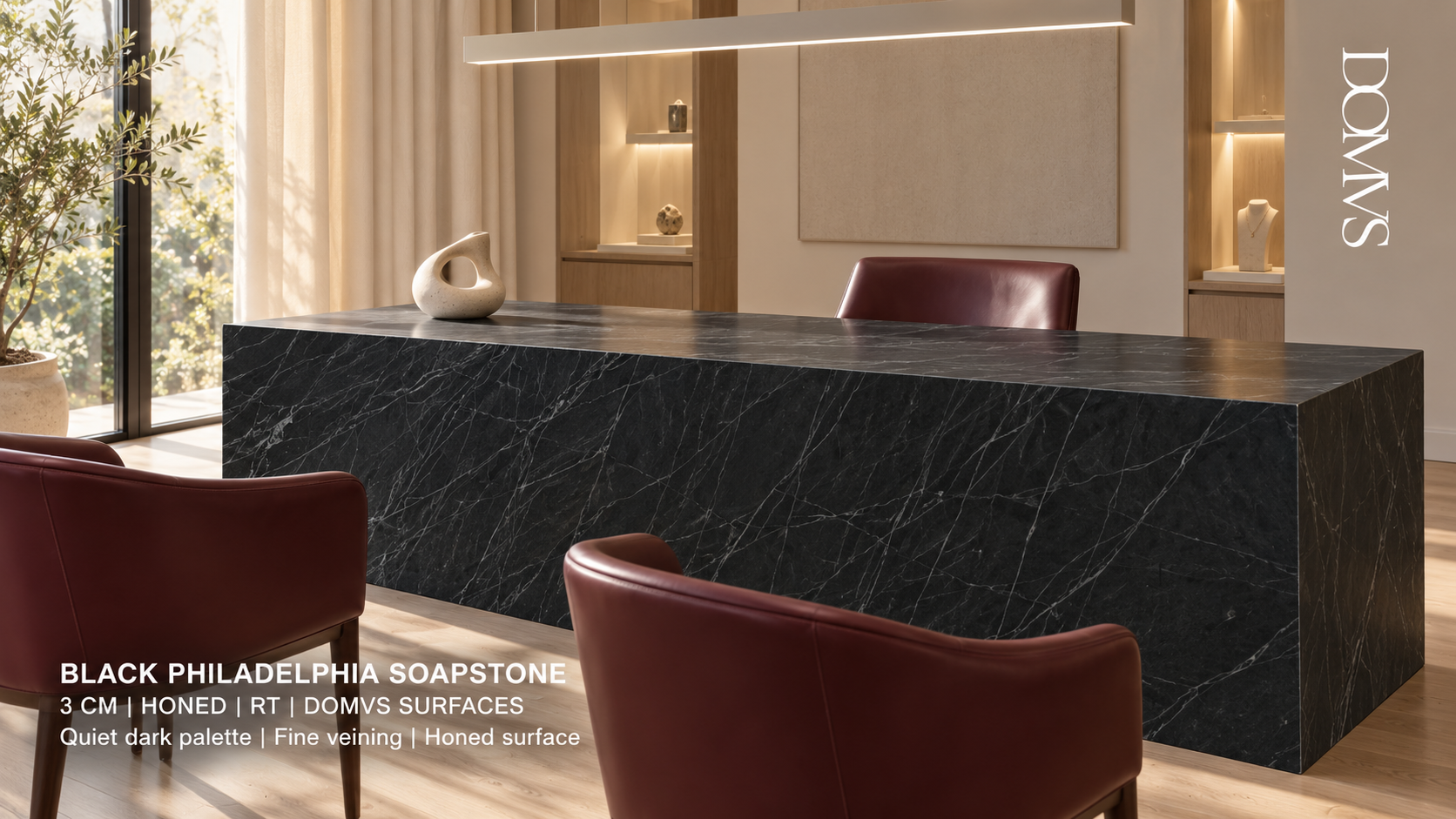
Generated installation inspiration based on the supplied Black Philadelphia Soapstone RT slab photograph; not a completed DOMVS project. Confirm allocated slabs, dimensions, finish, fabrication and project-specific application requirements.