
A boutique-hotel coffee counter should feel welcoming while keeping ordering, collection and staff work clear. Paloma honed limestone provides a pale, quietly marked starting point for an original contemporary café concept: coastal brightness, industrial structure, cheerful accents and satin brass hardware.
The supplied BV filename identifies a 2 CM variant within a stated slab range of 110–122 × 58–62 IN. The presentation also lists 2, 3 and 5 CM options; confirm the allocated material and current availability before specifying. Neither that list nor a rough-edge reference establishes the pictured counter as solid 5 CM stone. Start with the slab selection, then resolve the assembly.
Draw the ordering sequence before shaping the counter
Map where a guest reads the menu, orders, waits and collects a drink. Give staff separate routes for replenishment, clearing and equipment access. A cheerful room loses clarity when a pickup queue crosses the ordering position or obstructs the hotel’s main circulation.
For the interior designer, the palette connects pale limestone, satin brass and contemporary industrial details. The architect should coordinate clearances and any required accessible service position; the developer and operator should approve the service brief. The general contractor and fabricator need equipment templates, plumbing, electrical routes and support details before stone cutting. Discuss the intended scope through custom capabilities.
Ten design benefits to evaluate with the actual sample
These are conditional design and coordination opportunities drawn from the supplied appearance and proposed application, not tested performance advantages.
A light material foundation. The supplied photograph shows an ivory and pale beige field that can establish a bright base for the café palette.
Quiet close-view detail. Small natural markings give the counter visual interest without a strongly directional vein competing with signage.
A warm brass pairing. Satin brass can be sampled against the stone’s warm undertones rather than selected from isolated finish photographs.
A defined honed finish. A honed sample establishes the intended finish for review under daylight and service lighting.
A tactile edge study. The rough chiseled reference can inform a distinctive guest-facing edge, subject to a fabricated sample and practical review.
Thin-material clarity. The identified 2 CM variant gives the fabrication discussion a starting thickness, while any deeper-looking edge remains a separate assembly decision.
A preliminary layout range. The supplied 110–122 × 58–62 IN range can frame initial discussions; each allocated slab still needs actual measurements and sound-yield checks.
A focused arrival feature. The coffee counter can carry the stone while supporting walls and furniture keep the room legible.
A coordinated material contrast. Pale stone can be compared with industrial metalwork, cheerful color and coastal textures in one sample meeting.
A care-led specification. Testing the sample against the operator’s actual routine can expose maintenance expectations before the design is committed.
Treat the chiseled edge as a fabricated detail
A rough chiseled edge can introduce tactile contrast to a honed face, but its projection, depth and fabrication need a physical sample. Draw the guest-facing edge and its relationship to the joinery. Check how clothing, bags, cleaning cloths and staff movement interact with it; do not assume an attractive reference is the right working edge for every service position.
If the inspiration image appears thicker than nominal 2 CM, obtain a section explaining the construction. An assembled fascia or other built-up treatment is not a solid 5 CM slab. Confirm the actual method with the fabricator rather than calling the edge monolithic. Coordinate support, attachment, joints and sound areas independently.
The supplied length and width are a range, not a cutting guarantee. Approve a current slab photograph and measurements, mark each part and preserve the small-scale natural markings. Do not stretch one source photograph across an arbitrary room-length counter. Keep the review with the relevant catalog references and coordinating material collections.
Make acid etching and limestone care part of the café brief
Questions about how to clean limestone slabs should be answered before selection. Limestone is a calcareous stone: acidic liquids and acidic cleaners can etch its surface. A honed finish does not remove that sensitivity. The Natural Stone Institute care guidance recommends stone-appropriate cleaning and explains that an impregnating sealer can improve stain resistance but does not make stone stain-proof.
Review the operator’s actual drinks, cleaning products, spill response and treatment recommendations with the stone supplier. Retain an approved finish-and-edge sample. Separate concerns about staining from etching; a stain-repellent treatment is not a promise that acidic exposure will leave the finish unchanged.
Separate the guest-facing concept from food-preparation approval
This is a hotel coffee-counter planning study, not a certification of food-contact suitability or a cleanability determination. Identify which surfaces handle equipment, open food, wet work or repeated spills. Obtain the necessary material, treatment, fabrication and operator review for each intended task, including applicable food-service requirements. If another surface is appropriate for a working zone, coordinate it deliberately instead of forcing every operation onto limestone.
Equipment heat, concentrated loads, water interfaces and rough-edge cleaning need their own assessment. An image without food platters or visible equipment connections cannot resolve those issues. The DOMVS FAQ can organize initial enquiries; it is not an installation or sanitation specification.
Questions to settle before specifying the café counter
Does sealing prevent limestone from etching?
No. Do not treat stain resistance as acid resistance. Confirm a maintenance approach for the selected Paloma sample and decide whether the operator accepts its care requirements. Compare current material options if those expectations do not fit the brief.
Can the rough edge be specified directly from a picture?
Use the picture as a visual direction, then approve a fabricated edge sample and a dimensioned section. Confirm the construction and cleaning access; the reference does not establish a solid 5 CM thickness or the suitability of every contact surface.
Is this an actual Malibu café or a hotel project?
No. The imagery is an original generated design concept using a cheerful coastal-industrial atmosphere. It does not depict a completed DOMVS installation or imply affiliation with Malibu Country Mart, La La Land or another venue.
Approve the material, service plan and care routine together
Design teams in New York, Chicago, Miami, Denver, San Francisco and Utah can use the same sample-and-drawing process with their own operator and contractor. These are coordination examples, not local inventory, project or regional-performance claims. A landscape architect considering an outdoor extension needs a separate exposure review.
Bring the Paloma sample, edge mock-up, equipment schedule and support section to the design trade programme discussion. Arrange a complimentary design consultation, or request a Paloma limestone BV sample and project quote with drawings, quantity and intended application.
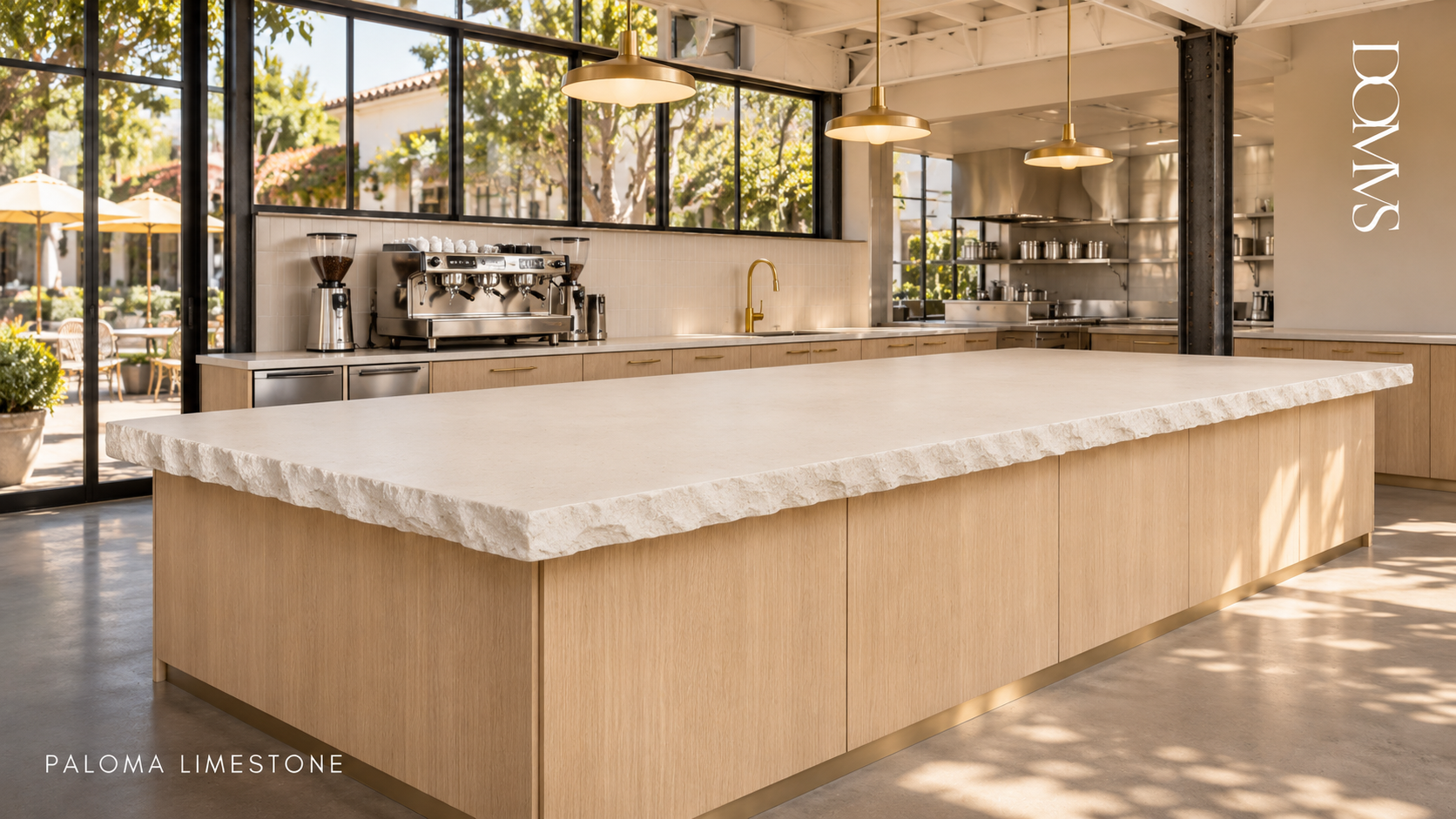
Generated boutique-hotel café design inspiration. Edge construction, thickness, support and food-service suitability require project review; not a completed DOMVS project or an affiliated venue.