
How should a commercial basement combine natural limestone with coordinating porcelain? Begin with the traffic, moisture and maintenance brief, then assign each material an appropriate role. Porto Beige limestone and Porto Beige Tech porcelain offer a palette to compare, but a coordinating colour does not make their physical properties or installation requirements interchangeable.
The honed Porto Beige limestone slab is 109 × 65 IN, with 2, 3 and 5 CM thickness options. The coordinating matte Porto Beige Tech porcelain field tile is 24 × 24 IN, with a matte 2.9 × 11.9 IN bullnose. Confirm the selected thickness and product-specific technical data before approving any commercial floor. See the existing Porto Beige limestone entry and request the actual samples together.
Limestone tile vs porcelain: decide by zone
A useful answer to the limestone tile vs porcelain comparison is a schedule of where each material goes. For this basement concept, review porcelain field tile for the circulation floor and natural limestone for a separately detailed reception face or wall. These are proposed applications subject to approval, not a claim that the supplied products are tested for heavy commercial traffic.
An interior designer can coordinate the palette; an architect can resolve transitions, access and assembly requirements. Developers and general contractors should establish who approves substrate preparation, flooring performance and maintenance. A landscape architect linking the interior to an exterior stair or courtyard needs a separate exterior review; this concept does not establish outdoor suitability.
What does high traffic require from the actual product?
Ask for the manufacturer's declared use classifications and relevant test reports for the exact tile and finish. Describe pedestrian volumes, wheeled loads, grit, expected spills and cleaning equipment. Do not infer wear resistance, breaking strength or wet-use suitability from the word porcelain, a photograph or the word Tech.
The Tile Council of North America's friction guidance explains that a coefficient of friction is only one part of suitability. Surface condition, contaminants, traffic and maintenance matter too. Obtain current product-specific information and the project team's assessment; no floor is being presented here as slip-proof.
Resolve basement moisture before choosing the adhesive
A commercial basement floor needs a substrate investigation, including cracks, movement, moisture conditions and any water entry. Do not treat a dense tile face as a cure for moisture in the concrete or as proof of a waterproof assembly. Select the preparation, mortar, membrane and grout as a compatible system for the measured conditions.
LATICRETE's concrete-moisture technical note discusses why moisture conditions and adhesive type matter. Its product and regional guidance is not a universal acceptance limit for this project. Have the installer and system manufacturer specify the testing and acceptance criteria for the chosen assembly.
Coordinate build-up and movement details through the custom capabilities enquiry, with catalog references and approved installation documents kept together.
Ten coordination benefits of a paired palette
These are conditional design opportunities, not claims of tested performance.
A coherent colour study. Comparing actual Porto Beige samples can connect floor and architectural surfaces.
Different material roles. Separate zones let each assembly be reviewed against its own demands.
A defined floor module. The supplied 24 × 24 porcelain tile gives the layout a starting grid.
A planned edge piece. The supplied bullnose trim can be tested at an approved termination.
A slab planning envelope. The 109 × 65 IN format helps organise preliminary wall or reception components.
Thickness options. The limestone's supplied 2, 3 and 5 CM options allow a deliberate section discussion.
Clear transitions. Drawing the meeting of stone, tile and adjacent finishes can resolve heights early.
A maintenance division. Separate care instructions can follow the two materials rather than one generic cleaning label.
A useful mock-up. A joint sample can expose colour, grout and lighting differences before ordering.
Coordinated sourcing. Discussing the limestone, field tile and matching matte bullnose together with DOMVS can simplify sample comparison and ordering coordination; confirm quantities, lots, availability and delivery for each item.
Detail the bullnose without assuming its role
The 2.9 × 11.9 IN bullnose is a coordinating format, not automatic approval as a stair nosing, coved sanitary base or load-bearing edge. Its matte finish is confirmed. Confirm its profile, thickness, orientation and manufacturer's intended applications. Draw the termination and inside/outside corners. Review the grout joint and modular fit against the 24-inch field tile rather than assuming the nominal dimensions align without cuts.
Assess the limestone slab's usable area and support requirements independently. Do not describe the slab as 24 × 24 limestone tile or promise that its offcuts will supply a floor. Compare related material collections and current arrivals if a different format better resolves the detail.
Make cleaning part of the specification
For limestone tile cleaning, the Natural Stone Institute recommends stone-appropriate care and notes that grit can abrade stone. Its limestone guidance discusses acid sensitivity and absorption. Choose a limestone tile cleaner compatible with the actual finish and treatment; acidic products can damage calcareous stone. A sealer does not make stone stain-proof.
Obtain separate porcelain cleaning guidance for the exact product, grout and installation system. Confirm equipment, chemicals, rinsing and drying with the facilities team. For a Chicago basement conversion or a New York hospitality renovation, document the local project's moisture and operating conditions rather than treating one palette as a universal solution.
Questions before ordering
Is Porto Beige Tech proven for heavy commercial traffic?
Not from the supplied images and dimensions alone. The matte finish is confirmed; supporting performance documentation remains to be confirmed. Match the exact product data to actual traffic and loads.
Can porcelain solve basement water problems?
No such claim is made. Investigate the source and nature of moisture, then design and approve the complete substrate and installation system.
Will the limestone and porcelain match exactly?
Coordination does not mean an exact match. Compare current physical samples, actual lots, grout and lighting in a mock-up. Natural stone variation and a manufactured tile pattern should be evaluated together.
Bring the samples and operating brief together
Use the project FAQ to organise outstanding questions, and the design trade programme for coordination. A complimentary consultation can frame the material choices. Request Porto Beige samples or a project quote with quantities, intended zones, finish selection and the technical information needed for approval.
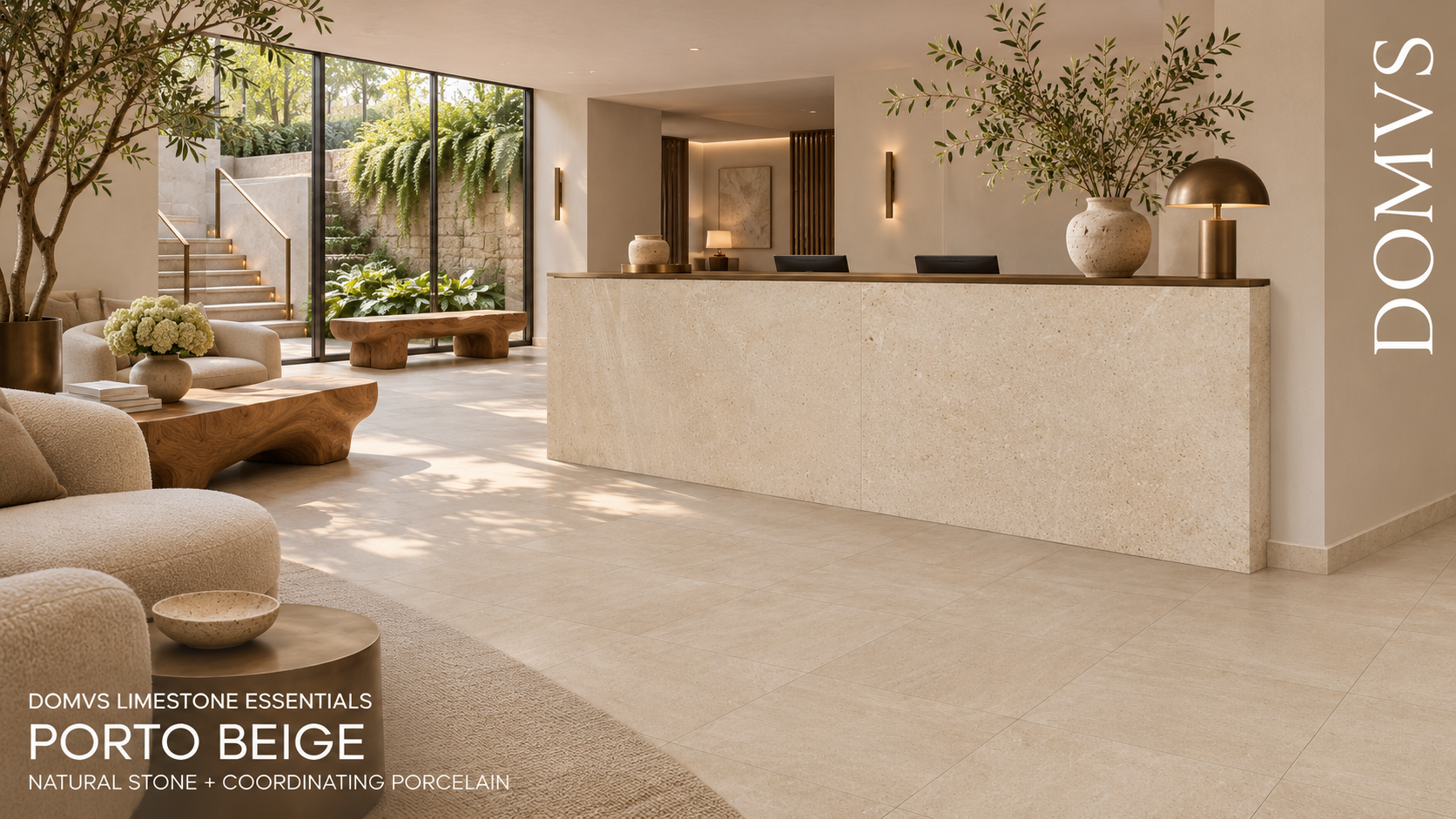
Porto Beige limestone and coordinating porcelain in an original lower-ground hospitality design study.