
Specify a marble side table by resolving its footprint, selected slab crop, edge, supporting base and care routine together. For Arabescato Polished JS, the supplied white and ivory field with diagonal grey veining provides the visual starting point. The material name and photograph do not establish load capacity, a safe overhang or an approved furniture assembly.
This selection is supplied as Arabescato marble, 112 × 76 inches, 2 CM, polished, backend code JS. Begin with the Marble Slabs selection and compare the wider slab range. Keep this JS record separate from the other Arabescato Corchia products; names that sound related do not prove identical batches, dimensions or vein arrangements.
Design for the seated user
In a hospitality reading lounge, a side table must work beside the actual chair. Establish the height, reach and clear route before selecting a dramatic photograph. Consider the intended cup, lamp, book or device, then position those objects on the proposed top drawing. Keep a significant vein visible where possible without allowing appearance to dictate an awkward reach.
The generated lounge concept studies a 30 × 24-inch top at approximately 24 inches high on a walnut base, with a visible 2 CM edge. Its warm woods, rich upholstery and layered lighting draw on the broad vocabulary associated with Soho House; this is an original design concept, not a property image or completed DOMVS project. The separate social image considers a retail console in a brighter, tailored setting informed by J.K. Place. Neither scene confirms fabrication feasibility.
Ten benefits to assess in this Arabescato selection
These are conditional visual and specification benefits supported by the supplied presentation. They are not ten tested performance ratings, and their relevance depends on the actual project.
Light visual field: the supplied white and ivory areas offer a pale focal surface beside darker upholstery.
Directional composition: the diagonal grey veins provide a clear orientation to test against the chair and circulation route.
Close-view detail: fine secondary lines give the small top interest at the distance a seated guest actually sees it.
Warm and cool coordination: faint warm traces and charcoal-grey marks provide specific tones to compare with timber and metal samples.
Contrast of finishes: the supplied polished finish offers a light response that can be assessed against matte fabric and wood.
Slab-specific selection: approving the actual crop lets the designer choose where a prominent vein sits relative to everyday objects.
Clear material thickness: the verified 2 CM slab supports an honest thin-edge design study instead of implying an unverified solid block.
Known format for a cut study: the supplied 112 × 76-inch format gives the fabricator an initial layout boundary, subject to actual usable areas and cutting allowances.
Palette continuity: a related console or vanity can be considered in the same material vocabulary after its own suitability and assembly review.
Controlled use of a strong pattern: a small table can introduce the stone as a focused element without cladding the whole room.
Keep the vein scale consistent with the cut layout
A marble slab is not a repeatable graphic. The table should use a crop at the material's physical scale, rather than compressing an entire slab photograph into a small top. Ask the fabricator to mark the proposed piece on the actual slab image, including vein direction, edges, defects and allowances. The supplied gross size does not establish a guaranteed usable rectangle or the number of tops obtainable.
For polished marble furniture, inspect the selected crop under the planned light. Reflections and nearby fabrics may change its apparent contrast. Review the material catalogs for adjacent finishes and the coordinating collections when developing the wider palette. Do not assume a generated second surface represents an available matching slab or bookmatched pair.
Resolve the base and edge before fabrication
A 2 CM marble top needs a project-specific supporting assembly. Have the furniture maker and stone fabricator review backing, attachment, loads, stability, handling and edge protection together. A rendered pedestal is a design idea, not a structural calculation. If the brief changes to a deeper-looking edge, identify the proposed built-up construction rather than presenting it as a thicker slab.
Use the custom capabilities enquiry to discuss the detail before assuming a particular fabrication service is available. The same review applies to an Arabescato console table, vanity or wall proposal. Each application has different interfaces and exposures; permission to explore one is not approval of the others.
Connect the finish to the operator's care plan
Marble furniture care starts with the actual composition, finish and treatment. The Natural Stone Institute's care guidance recommends appropriate neutral cleaning and surface protection. Acidic products can etch calcareous stone; coasters and prompt attention to spills matter. A marble sealer may improve stain resistance but does not make stone stain proof. Confirm the compatible product and routine with the supplier for the allocated material.
For an interior designer, the decision includes acceptance of how a polished finish may change in use. Architects should coordinate the detail; developers should identify who approves the material and receives the handover; general contractors should protect it through installation. Landscape architects linking an interior lounge to a terrace need separate exterior evidence. This interior image supplies no outdoor approval.
For New York and Chicago projects, confirm the actual building's access and handling route before fixing the furniture size. In Miami or Denver, ask the operator how daily drinks and cleaning will be managed. San Francisco and Utah teams should review a sample under their actual lighting rather than assuming a warm rendering predicts every room. These examples establish no local office, inventory or completed project.
Questions before the final selection
Can a marble slab near me be assumed to match this Arabescato?
No. Verify the actual material, slab photograph, JS code, dimensions and finish. A nearby listing or similar product name does not establish the same batch. Review current arrivals for selection context and confirm allocation directly.
Does polished marble remove the need for coasters?
No. Polish describes the finish, not immunity to stains or etching. Specify protection and compatible cleaning for the actual operating conditions.
Can this idea work outside hospitality?
A retail waiting area, commercial client lounge or high-end residential reading corner may explore a similar table. Review its actual users, furniture geometry, cleaning and supporting assembly separately. The general project FAQ supplies enquiry context, not product-specific technical approval.
Professional teams can explore the Design Trade Program, arrange a complimentary design consultation, or request a sample and project-specific quote for Arabescato Polished JS. Include the intended application, drawing and finish questions so the material review starts with a clear brief.
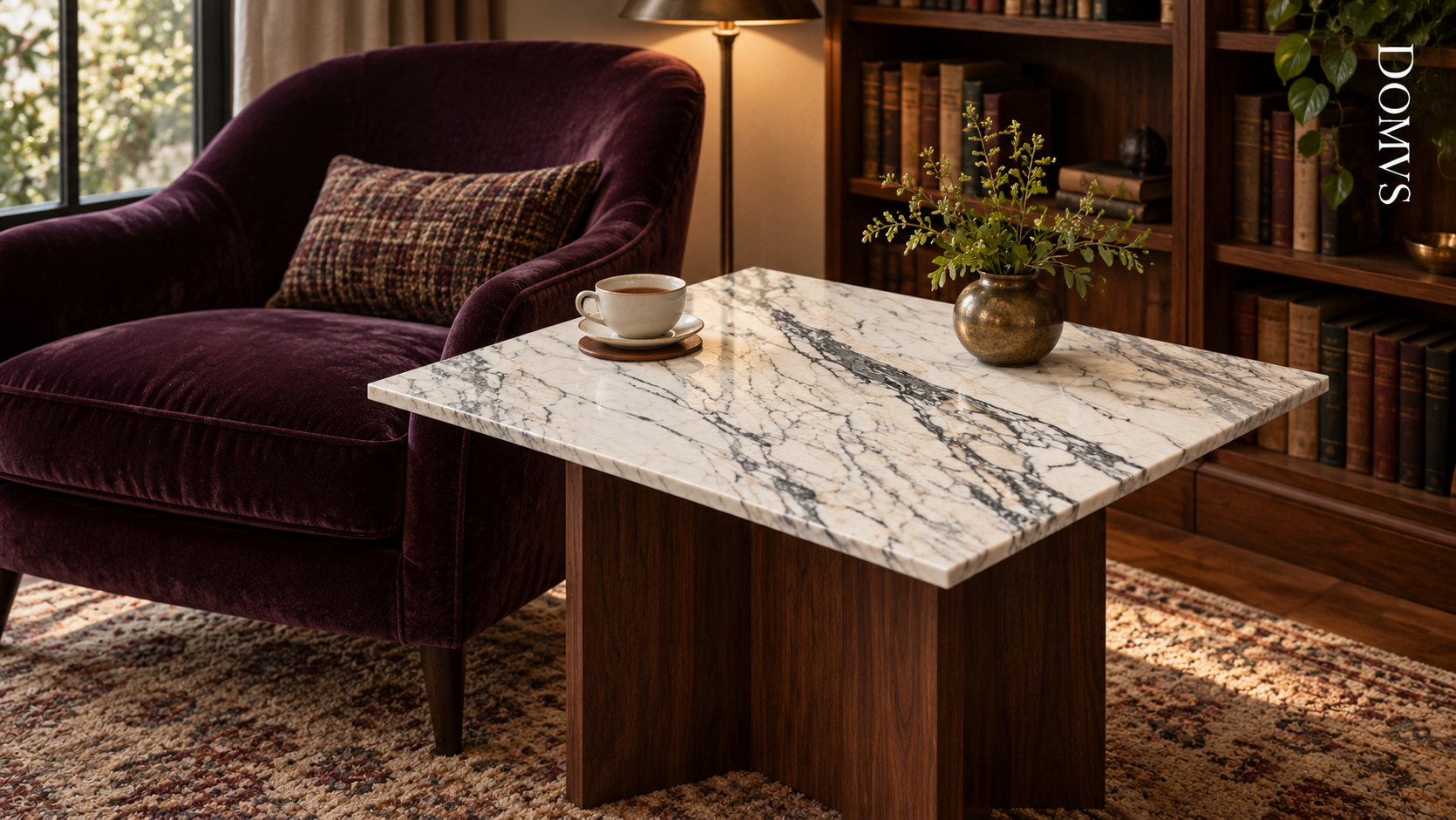
Generated installation inspiration featuring Arabescato Marble JS; not a completed DOMVS project. Confirm actual slab crops, fabrication, support and project-specific suitability.