
A honed black basalt wall can give a boutique hotel interior a calm visual anchor. Its success depends as much on the sample, lighting and cleaning routine as on the photograph. Black Basalt Brick Veneer is confirmed in a 2 × 24 IN format, with 3/8 IN and 3/4 IN thickness options. This guide concerns wall veneer, not a floor-rated product.
For interior designers, architects and hotel developers, the practical question is how to approve a honed basalt interior wall that housekeeping can maintain consistently. Fingerprints, wipe marks and cleaning residue should be evaluated on the actual sample; do not promise that a dark finish automatically hides or shows them.
Approve the wall at guest viewing distance
Build a sample panel using the proposed unit layout, joint material and edge condition. Review it from the entrance, seating position and near-touch distance. The2×24IN module has a12:1 face proportion; the drawing should preserve that long narrow rhythm around doors, signage and outlets.
Bring the final light source to the mock-up. Record the accepted appearance under normal daytime and evening conditions rather than judging a phone photograph alone. Compare broader basalt formats only as different products; slab specifications do not transfer automatically to veneer.
Ten design benefits to test before selection
These are conditional visual and coordination opportunities, not tested performance ratings.
Dark visual anchor. The charcoal honed reference can establish a focused backdrop within a lighter hotel interior.
Long horizontal rhythm. The confirmed2×24IN format offers a12:1 module for studying courses and openings.
Controlled joint composition. A sample panel can establish joint width and color before the full wall is committed.
A honed finish benchmark. A retained honed sample gives housekeeping and design teams a common visual reference.
Near-view detail. The supplied fine texture can be assessed at guest touch distance rather than only in a rendering.
Lighting coordination. A full-size mock-up can show whether intended lights exaggerate wipe marks or edge variation.
Two thickness options. The confirmed3/8IN and3/4IN options permit an assembly comparison without assuming either is universally suitable.
Focused wall placement. A selected interior wall can carry the material without implying floor, wet-area or exterior approval.
Service-detail integration. Outlets, signage and edge trims can be coordinated to the veneer module before installation.
Care-led selection. An agreed cleaning demonstration can expose maintenance expectations before handover.
Turn the fingerprint question into a cleaning demonstration
Ask the operator to demonstrate the proposed cleaning method on a loose sample or mock-up. Compare an untouched area, normal handling and the cleaned result after drying. This is a practical acceptance exercise, not a formal stain or abrasion test. Obtain the supplier’s recommendations before applying products or treatments.
The Natural Stone Institute care guidance supports stone-compatible cleaning, appropriate dilution and removal of cleaner residue. Excess product can leave a film. Establish the actual cleaner, cloth and drying routine with the supplier and operator; a sealer does not make stone stain-proof.
Keep a retained sample and a short approved care record. Housekeeping should know how to report a mark that routine cleaning does not resolve rather than improvising with stronger chemicals or abrasive tools. Questions about how to clean black basalt should lead to product-specific instructions, not a generic promise of maintenance-free stone.
Coordinate the veneer assembly before installation
Thickness is only one part of the wall detail. The architect and general contractor must coordinate substrate, attachment, joints, corners, terminations and service interfaces with the responsible installation-system supplier. LATICRETE’s wall-finish system resources illustrate that an adhered finish belongs to an assembly; they do not approve this exact basalt veneer or select a mortar for the project.
Resolve cut units at the ends of a feature wall, the position of switches and how the material meets adjacent paint or joinery. Discuss the scope through custom capabilities, retaining the sample and shop drawings with catalog information.
Questions for the hotel design and operations team
Is honed basalt guaranteed to resist fingerprints?
No fingerprint-resistance evidence has been established for this product. Compare handling and cleaning on the actual finish under the planned lighting before accepting it. Finish names describe a selection, not a warranty about marks.
Should the thicker veneer always be chosen?
No. Confirm the appropriate option for the substrate, attachment, edge and interface design. Neither3/8IN nor3/4IN is a universal installation approval. Use the DOMVS FAQ to frame initial questions.
Is this one of the most popular basalt finishes?
No independent ranking is established here. Select the finish for the project and actual sample. Compare the material collections and current arrivals without treating popularity language as technical evidence.
Connect design approval with handover
A hotel team in New York or Chicago can use the same sample-and-cleaning review as a team in Miami, Denver, San Francisco or Utah, applying its own operator requirements. These are process examples, not local inventory or performance claims. A landscape architect considering an outdoor application needs a separate exposure review.
Bring the finish sample, lighting plan and care demonstration to the design trade programme discussion. Arrange a complimentary design consultation, or request honed Black Basalt Brick Veneer samples and a project quote.
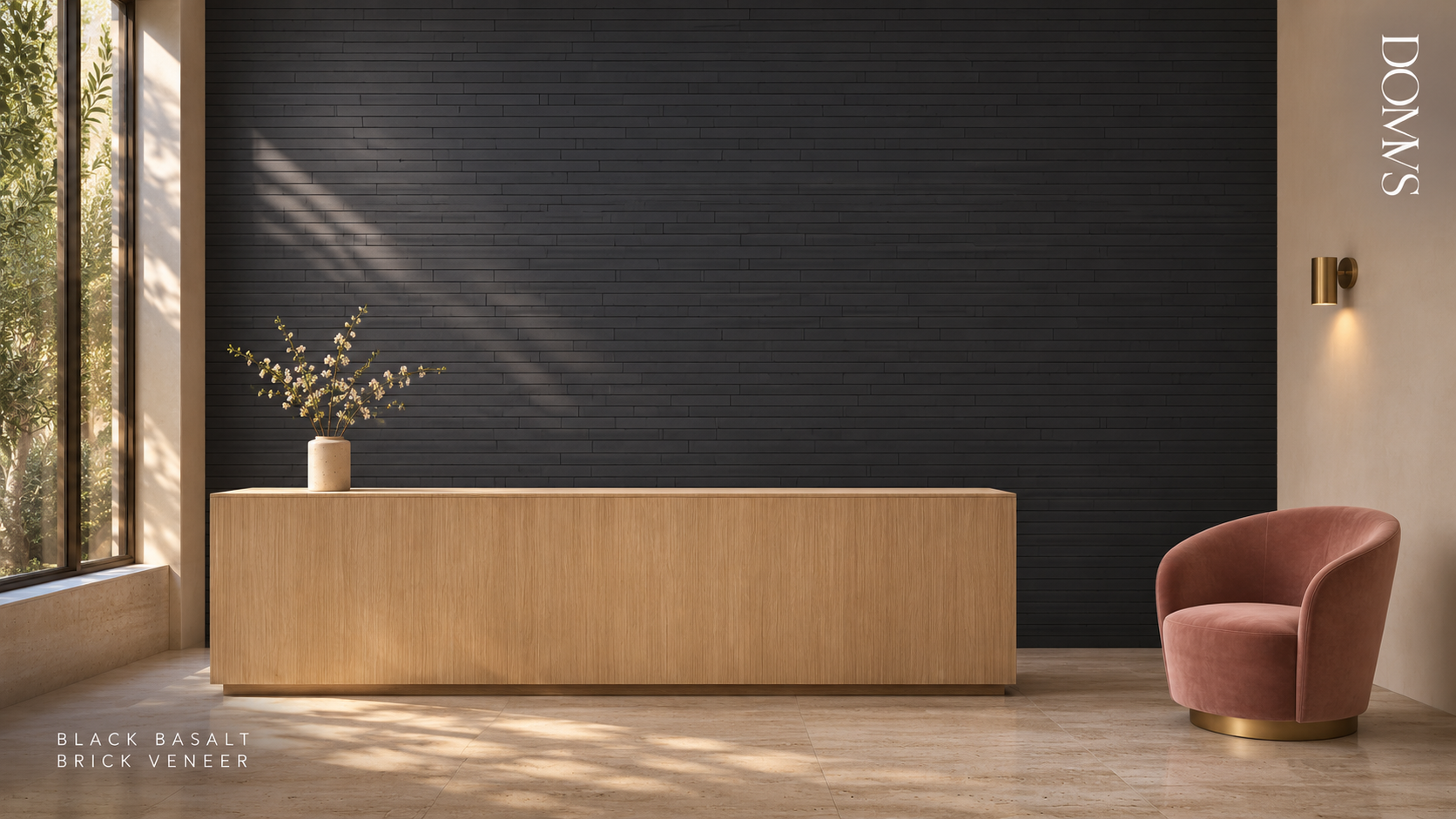
Generated hotel interior design concept. Veneer attachment and maintenance require project-specific approval; not a completed DOMVS project.