
A Silver Classic Extra Travertine dining table can give a residential dining room a strong material center without filling every surface with stone. The supplied BV slab is vein cut, honed and filled, 116 × 69 IN × 2 CM. Its cream ground and broad grey layers provide the visual reference; the finished table still needs a fabricator’s layout and a properly designed base.
For interior designers, architects and developers, start with Silver Classic Extra Travertine as a specific slab selection, not a generic image of travertine furniture. Review the wider slab range if the project’s size, finish or appearance requires an alternative.
Connect the tabletop to the people using it
The generated residential dining concept studies an approximately 80 × 38 IN top at a 30 IN table height, above a dark metal support structure. These are visual concept dimensions, not a furniture specification. Confirm chair width, knee space, circulation, base position and the expected use before ordering the stone.
A nominal 2 CM top should not be drawn as a massive block to imply strength. The stone fabricator and furniture designer must coordinate support, fixing, edge details, handling and loads. Base design cannot be approved from a photograph. Discuss the proposed scope through custom capabilities and retain a section through the actual assembly.
Ten design benefits to evaluate before approval
These are conditional visual and coordination opportunities, not tested durability or structural claims.
A clear horizontal axis. Broad grey layers can organize the table’s relationship to the room; their orientation should be shown on the cutting drawing.
A cream-and-grey palette. The supplied photograph offers a reference for coordinating pale upholstery, dark metal and wall colors without claiming a universal color match.
Close-range mineral detail. The stone provides variation where diners see it closely, subject to approving the actual slab and sample.
A specified honed finish. A honed sample establishes the intended finish rather than relying on the shine of a rendering.
A filled face to review. The filled designation directs attention to the finished face and its fill appearance, without identifying an unverified filler chemistry.
A thin top profile. Nominal 2 CM material supports a restrained visual edge when the table structure is designed accordingly.
An initial layout envelope. The supplied 116 × 69 IN gross format gives the fabricator a starting point, not a guarantee of finished top yield.
A focused centerpiece. A single tabletop can establish the material’s role while other room surfaces remain quieter.
A coordinated base conversation. The stone and base can be reviewed as one furniture design, including support, fixing, knee space and movement.
A related console study. A separate supported console top can extend the palette into another setting without repeating the dining-room composition.
Use an actual slab layout, not a repeated texture
The source format is 116 × 69 IN, but gross dimensions do not establish sound yield. Mark the proposed tabletop on a current slab photograph and ask the fabricator to show trimming, exclusions and usable boundaries. The broad bands should retain a credible physical scale; do not compress the whole photograph into every small top.
Decide which edge faces the main room view and how the bands meet that edge. Separate parts should be drawn individually. Do not infer bookmatching, continuity across different slabs or availability of matching future pieces. Keep the selection record with the relevant catalogs and collection information.
Separate honed and filled from maintenance expectations
Honed and filled describes this product’s supplied finish. The general filled and unfilled travertine explanation describes filling natural voids, but does not identify this slab’s filler chemistry. Request the relevant information for fabrication and cleaning decisions.
The Natural Stone Institute care guidance supports using appropriate stone cleaners and protecting calcareous stone from acidic products. Plan coasters, prompt spill removal and a suitable cleaning regime; a sealer does not make stone stain-proof. Confirm any treatment with the supplier rather than promising a maintenance-free dining surface.
Coordinate the sample meeting across the project team
Ask the interior designer to bring upholstery and finish samples; the architect and furniture specialist should bring the section and base layout. The general contractor can coordinate delivery and access where the table is part of a larger fit-out. A developer should retain the approved material record for purchasing and replacement discussions.
Whether the team works in New York, Chicago, Miami, Denver, San Francisco or Utah, use the actual project lighting and operator expectations to review the sample. These are process examples, not claims of local stock, installations or regional approval. Landscape architects considering an outdoor dining setting need a separate exposure and assembly assessment.
Questions designers should resolve before cutting
Is a 2 CM slab sufficient without a supporting frame?
Thickness alone cannot answer that question. Obtain a base and attachment design appropriate to the actual stone, dimensions, loads and conditions. The DOMVS FAQ can organize initial enquiries; it does not replace furniture engineering.
Does travertine versus soapstone identify the better dining surface?
That comparison is a useful starting question, not a universal ranking. Compare the exact products, finishes, maintenance requirements and appearance with the client’s priorities. Consider current material options with actual samples.
Can a console use the same material language?
Yes, as a separately assessed design study. The distinct social image shows a thin stone console top above a supported cabinet in a hotel library. Its geometry, support and cutting layout differ from the dining table; the image is inspiration, not proof of a fabricated product.
Approve the selection and the furniture detail together
Bring the current slab photograph, honed filled sample, tabletop layout and support section to the design trade programme discussion. A complimentary design consultation can help clarify the selection questions. Request a Silver Classic Extra Travertine BV sample or project quote with the intended application and required quantity.
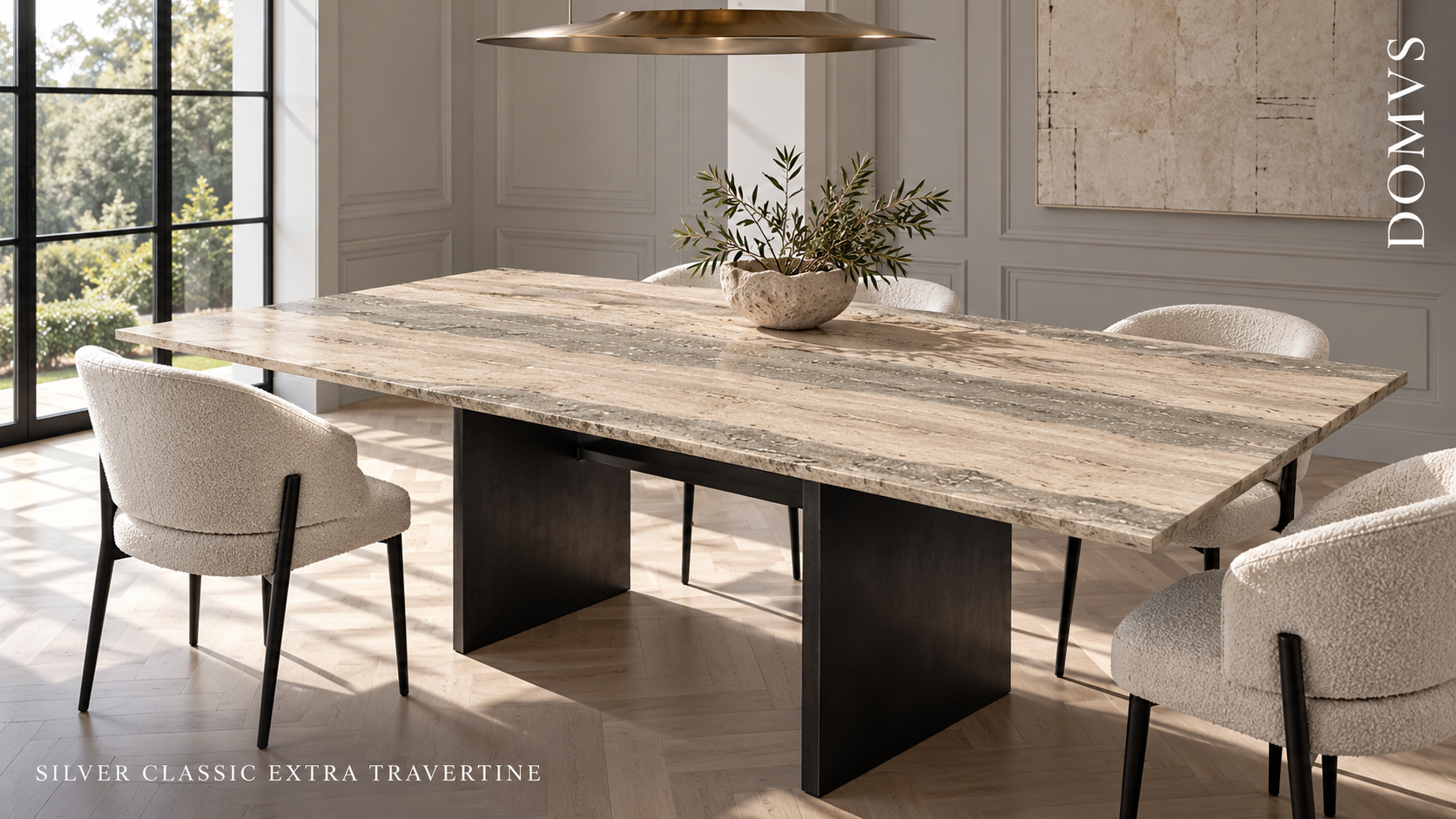
Generated residential dining inspiration. Table dimensions, stone support and fabrication require project-specific approval; not a completed DOMVS project.