
A travertine coffee table can give a hotel lounge a clear focal point when its grain, edge construction, support and care plan are resolved together. Titanium Dark travertine offers a warm taupe, brown and grey palette with horizontal mineral bands. Treat those visible qualities as the starting point for a specification, then approve the actual slab and the complete furniture assembly before fabrication.
The supplied product is a vein cut travertine slab, 116 × 69 inches × 2 CM, polished and filled, with backend code BV. Review the Travertine Slabs selection for material context and compare the wider slab collection before deciding which stone best fits the brief. Gross slab dimensions do not establish the usable cut size or an approved unsupported span.
Start with the lounge experience, not a thickness effect
In hotel lounge design, the table must serve seated guests as well as the room composition. Set its footprint against the actual sofa and chairs, circulation route, service routine and intended objects. An interior designer can then align the directional stone with the seating arrangement rather than placing a finished table wherever space remains.
The generated concept pairs Titanium Dark with walnut, cognac leather, olive upholstery and soft lighting. It uses the broad layered vocabulary associated with Soho House as design inspiration for an original room. It does not depict a Soho House property, a completed DOMVS project or an endorsed collaboration. The deep-looking stone edge is a conceptual assembled fascia, not evidence that the supplied slab is thicker than 2 CM.
Ten benefits to evaluate in the actual slab
The following are distinct visual and specification benefits supported by the supplied appearance and product information. Their value depends on the project; they are not claims of tested load capacity, stain immunity, outdoor suitability or reduced maintenance.
Directional emphasis. The long horizontal bands provide a clear orientation for the table. Running the approved grain with the seating group can reinforce its composition.
A bridge between warm and cool finishes. Beige and brown sit alongside grey in the photographed slab, giving the designer specific tones to test against timber and metal samples.
A substantial visual anchor. The deeper taupe bands can give a low table definition beside softer upholstery without requiring another saturated finish.
Fine-scale interest. Thin mineral lines offer detail at seated viewing distance, where a guest sees the surface more closely than a distant wall.
Slab-specific character. The photographed pattern is visibly irregular. Approving the actual piece allows that individual arrangement to become part of the furniture composition.
A reflective finish to assess. The supplied polished finish offers a different light response from a honed alternative. A physical sample under the intended lamps makes that choice deliberate.
A filled-surface starting point. Filled travertine generally closes natural holes to create a smoother surface than an unfilled finish. Inspect this product's fill appearance and continuity rather than assuming every area is identical.
A known stock format for drawing studies. The supplied 116 × 69-inch dimensions give the team an initial boundary for a cut layout. Confirm actual usable areas, defects and allowances before promising a one-piece top.
A defined nominal material thickness. Knowing the slab is 2 CM lets the designer distinguish the real material from the desired edge expression. The fabricator can review a thin edge or an assembled fascia as separate details.
A coordinated material vocabulary. Walls, vanities and furniture are proposed applications for project review. Considering related elements together can support a coherent palette; each requires its own assembly and suitability confirmation.
Resolve the table as furniture, not an unsupported slab
A natural stone table needs a coordinated base, backing and connection detail. Ask the furniture maker and stone fabricator to review the actual loads, handling, edge protection, attachment and stability. The supplied product dimensions and finish do not answer those questions. A rendered plinth is an illustration, not an engineering detail.
For travertine furniture with a deeper edge, map the fascia joints and the relationship between grain on the top and sides. Request a small edge mockup where appearance is critical. A polished travertine slab does not automatically produce a seamless box, and photography does not establish whether adjacent cuts will match. Discuss the brief through DOMVS custom capabilities before assuming a particular fabrication service or detail is available.
Use the DOMVS catalogs to compare the surrounding palette and coordinating collections for adjacent surfaces. Review current arrivals when considering alternatives; a listing does not reserve a slab for the project.
Make procurement and care part of the design
For a New York or Chicago project, confirm the actual building's loading route, lift access and furniture delivery sequence before fixing the table size. For a Miami or Denver brief, ask the operator how drinks, cleaning and daily service will work around the table. These are project questions, not claims of local inventory or completed installations.
In San Francisco and Utah, view the slab sample beside the actual upholstery and lighting schedule, rather than assuming that a warm rendering predicts its appearance in every room. Architects and general contractors should coordinate the base and interfaces; developers should assign responsibility for approval and protection. Landscape architects planning adjoining outdoor spaces need separate evidence for any exterior proposal. This interior concept supplies no exterior approval.
The Natural Stone Institute's care guidance explains that acidic products can etch calcareous stone and that sealing improves stain resistance without making stone stain proof. Specify appropriate neutral cleaning, coasters and a prompt spill response; confirm the actual fill and sealer system with the supplier. Keep abrasive cleaners out of the routine. A polished surface still needs an operator's care plan, and a finish change over time should be discussed before selection.
Read the general project FAQ for enquiry context, then obtain written answers for product-specific matters it does not address. Retail client lounges, commercial waiting areas and high-end residential sitting rooms may explore a similar palette, but their use intensity, dimensions and detailing need separate review.
Questions designers ask before approval
Is Titanium Dark a granite or a travertine?
The supplied product is Titanium Dark Travertine. “Titanium” is its product name, not proof of a granite classification or a performance rating. Keep the verified material name, finish, dimensions and BV code together in the selection record.
How should a team compare travertine vs soapstone for a lounge table?
Compare the actual samples, finish expectations, assembly and care requirements rather than choosing by color alone. This article establishes the supplied travertine specification; it does not assign soapstone properties to it or declare either material universally better. A matching dark tone is not evidence of matching maintenance or structural behavior.
Does filled mean stain proof or maintenance free?
No. Filling concerns natural holes and surface appearance. It is not a guarantee against stains, etching or wear. Confirm the fill type, sample acceptance and compatible care system for the allocated slab.
What should be submitted before ordering?
Include the table drawing, proposed top and edge dimensions, grain orientation, base detail, finish sample, access constraints and operator requirements. Travertine slab selection is complete only when the actual material and the proposed assembly have both been reviewed.
Professional teams can explore the Design Trade Program, arrange a complimentary design consultation, or request a sample and project-specific quote for Titanium Dark Travertine BV. Use the verified product name and intended application so the enquiry can be matched to the right material.
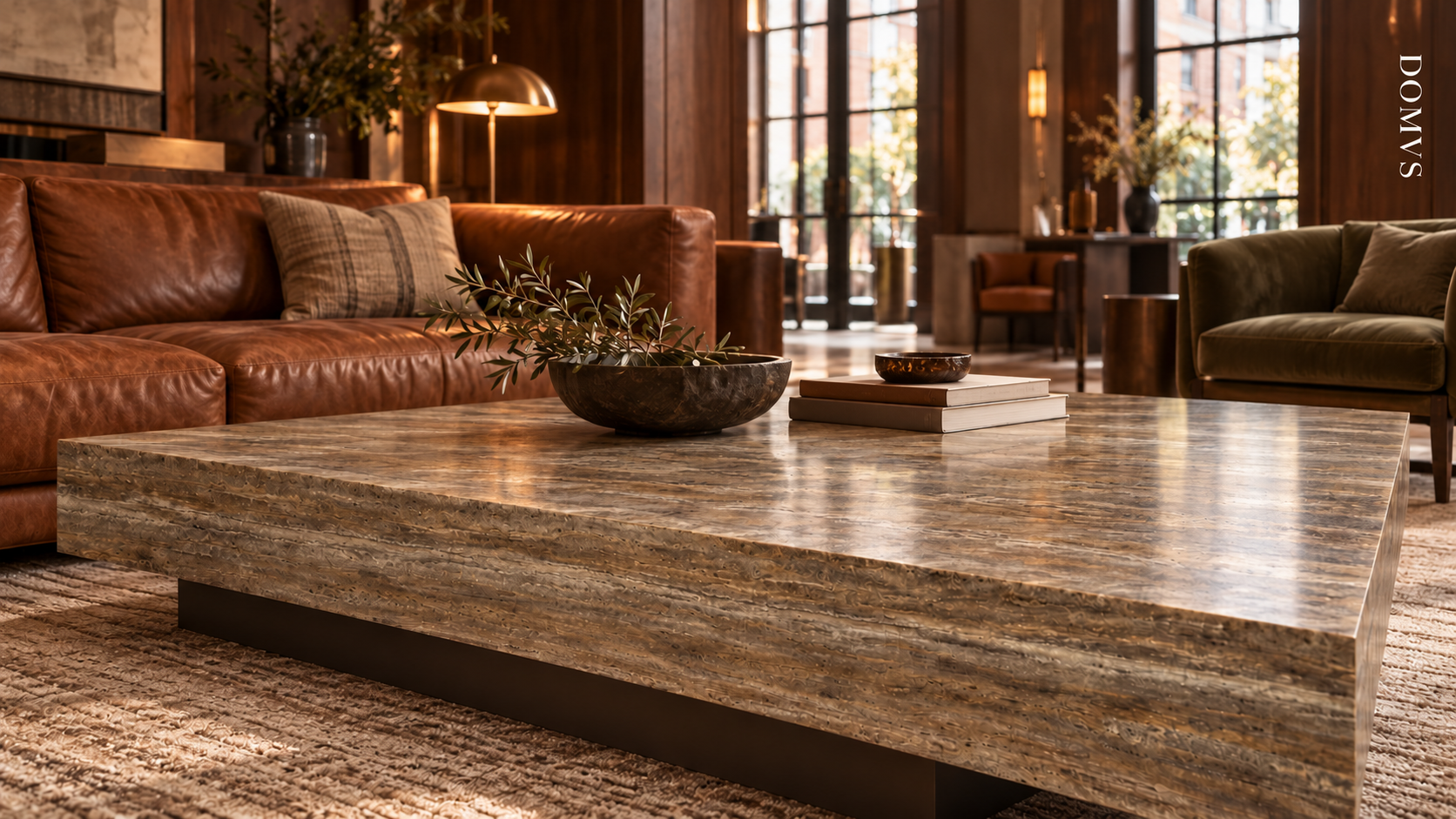
Generated installation inspiration featuring Titanium Dark Travertine BV. Original hotel lounge concept informed by Soho House's broad design vocabulary; not a real property, completed DOMVS installation, affiliation or endorsement. Deep edge illustrates an assembled fascia, not slab thickness. Final fabrication and support require project review.